Estrutura
Interview
September
2019
Fri
20
The performance “Party” celebrates the tenth anniversary of Estrutura and puts forward a family party. After a series of performances with a critical eye over mankind, resorting to apocalyptical future realities (“Geocide”), mediated identity issues (“The End”), the legacy of May 1968 (“M’18”) and the classical age (“Pathos”), what issues is “Party” trying to ignite? What did you try to explore based on the more frivolous topic of partying?
JOSÉ NUNES (JN) The fact is we ended a tetralogy with our last performance, and “Party” is a kind of interlude before the ones coming. We chose this performance in particular to make that transition between two thematic focuses, and because we don’t want to ignore the elephant in the room, which is the fact that we are celebrating ten years of activity this year. This performance is based on the idea of partying, but it isn’t necessarily lighter. We’re celebrating, but we’re also still reflecting on specific topics. We set ourselves out to think about this idea of celebration, partying, sharing, community and family, and on how one builds these milestones, since we, humans, came up with the notion of time, and we’re obsessed with them and with recording them. So this idea of celebrating isn’t just frivolous, but rather a chance to reflect on what it means to throw a party, and to celebrate an event or a milestone.
CÁTIA PINHEIRO (CP) And to celebrate family, to question what family means. In this case, an artistic family, who chose us and whom we’ve chosen, who’s been with us for the last ten years. The performance intends to understand what it means to journey together, how we look at the ten years that have gone by, and how we envisioned the ten years we had ahead of us. We want to think about what it means to live with family, to build a family, to raise, to look at the artistic object in a familiar way.
Identity is a very recurring topic in your work. This performance is about the path travelled by Estrutura. Does “Party” explore this topic in depth? In what way do you transfer the identity of Estrutura to the stage?
JN The starting point is the autobiographical milestone of celebrating ten years in 2019. Our identity will also somehow be present, because we set out to reflect on it, and given that we include autobiographical elements from the history of Estrutura and from the people who usually work with us. We want to transfer some of those elements to the performance we’ll create. We have an interest in having that as a starting point that then expands to discuss bigger things than this anniversary of Estrutura.
CP Yes, otherwise we’d bring a cake, we’d blow out the candles and we’d get drunk, which is also an anniversary classic [laughter]. We really want to question our identity, which is something we do in all our projects, be it thought-wise or in terms of the visual outcome. We always call ourselves into question. We don’t start from scratch; that would be impossible. But it will be inevitable to address identity as the great topic, because it’s also been in our minds for some years. And it will be fun to look back and see how we’ve built an identity or what may be our identity. But also how to seize something that is not exactly crystallised in our minds.
JN As in the case of any identity, it is often easier for the onlooker than for those who have it to build that identity. Because we’re often not what we think we are and define ourselves to be. In fact, we are what the others make us to be. That idea is always present, not only in the performances, but in ourselves as individuals.
You typically try to avoid theatre canons and resort to multimedia devices. What can we expect from “Party”?
CP I’d like this performance to kind of revisit all that’s behind us, even if we still don’t know if it will end up on stage.
JN There’s a series of visual elements we want to summon for this performance. And that also has to do with the identity of Estrutura, with trying to transfer it to the stage, and with being able to look at the path travelled. That is part of the proposal, whose premise is to look back at the ten years of work and to invite a group of artists to collaborate with Estrutura.
CP The idea is for them to be able to offer for lighting gifts, text gifts, video gifts. Our work has always a rather visual principle; we value text as much as image or video. As we see it, no element has more value than other. No actor is more important than a spotlight to the extent that everything contributes to the same artistic object.
JN There is no dramaturgic hierarchy, so to speak. Text, staging and playacting all have the same significance as the other elements in the performance. That is to say it may be a joint production where there really is no hierarchy when it comes to building meanings.
Favouring experimentation, you held several collaborations along the way. In what way did the chosen artists (José Maria Vieira Mendes, Rogério Nuno Costa, André Godinho, Vasco Rodrigues, Daniel Worm d’Assumpção, Jordann Santos, Pedro Nabais) contribute to the making of “Party”? Do the artists’ gifts turn out to be the starting point of the performance?
CP Yes, it really is a relational proposal. To get here and put something forward, instead of us presenting the topic on which we’d like to think. We have a topic, of course we do, but it is a way for them to be able to inject thought and provoke us. Asking them to provoke us is very important, and it will determine our reply.
JN Having collaborators sharing is also one of the key starting points of this project. Thinking our identity, even recycling some scenic materials from certain performances, and inviting a group of collaborators who make up our “family”. The idea we had for a performance-gift translates into inviting those collaborators for a residency with us, and then having them offering us a gift based on the work carried out during that residency. The project will be the result of combining all those work periods. And so we invited a group of collaborators with whom we’ve worked over the years, and others who’ll also participate and collaborate. And the audience!
Interview conducted on May 25, 2019, at Teatro Rivoli’s maintenance workshop, by Ana Luísa Sousa, intern of TMP’s communication office.
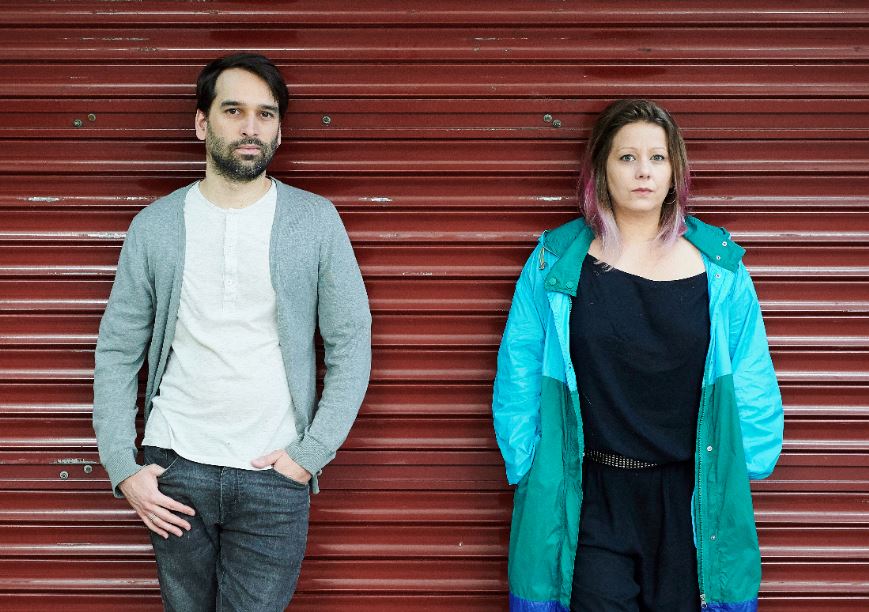
Photography © José Caldeira / TMP
Cátia Pinheiro & José Nunes
theatre directors and actors
theatre directors and actors