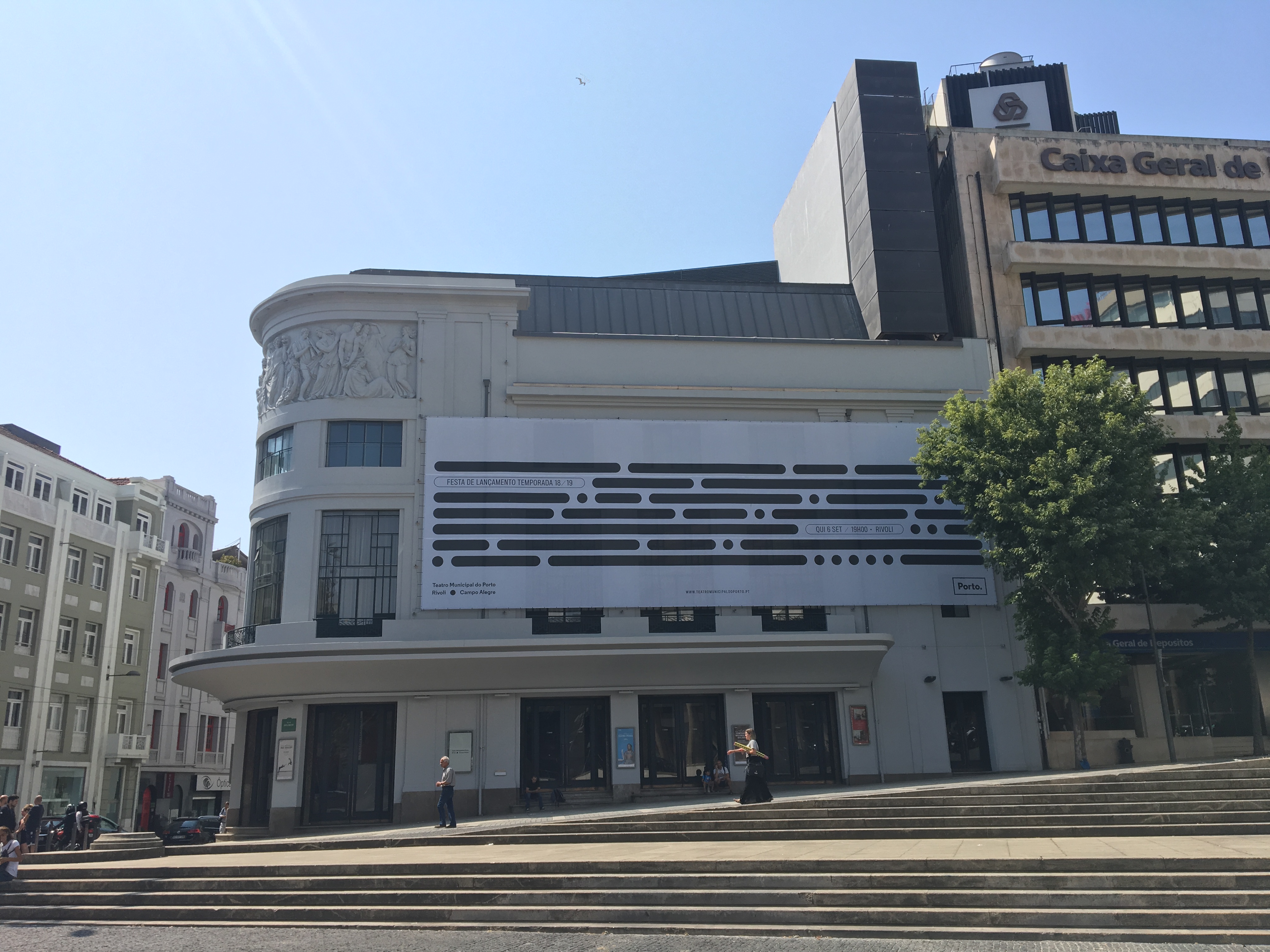
Story(ies)
— Part One
September
2018
Thu
6
The second programme will be released during Rivoli’s 87th anniversary, thus covering the rest of the season between March and July 2019.
This new programme is more than that. We thought of a programme-book that indulges a curious look at the performances, and thus it now takes on a more editorial nature, so that we may keep it and revisit it whenever we also feel the need to go back to the Theatre. We have rearranged the activities taking place at Rivoli and Campo Alegre in order to allow the reader-spectator to get a better understanding of what gives substance to Teatro Municipal do Porto: the programme we design, the partnerships, and the events and festivals we host. In contrast to the reading time this programme-book requires, we have optimised our on-line communication channels to provide quick and instant information. Wandering through the programme, I invite you to learn about the first part of my reading on the performances and different stories, from the history of dance to social and political history, but also to the per- sonal narratives and imagery of those who reinvent it.
Travelling back to the late 1970s and early 1980s, we return to the postmodern dance movement at Judson Church, in New York, portrayed by the LYON OPERA BALLET by means of two pivotal choreographic pieces that convey the importance of the collaborative effort between the choreographers, musicians and artists of that avant-garde community: “Dance”, by Lucinda Childs (1979), with music by Philip Glass and set design by Sol LeWitt; and “Set and Reset/ Reset”, by Trisha Brown (1983), with music by Laurie Anderson and set design and costumes by Robert Rauschenberg. Speaking of collaborative work, the inevitable ANNE TERESA DE KEERSMAEKER returns to Rivoli to present “A Love Supreme” together with Salva Sanchis, based on the album by the same name by John Coltrane. This performance takes us into a thrilling game of mirrors between jazz and dance improvisation.
Also back is theatre director and musician DOROTHÉE MUNYANEZA, who dances, sings and speaks of what’s almost unspeakable. “Unwanted” is a shock performance on the use of rape as a war tool during Rwanda’s genocide. The artist found those women who were the victims of inhuman cruelty, which is important to expose for future memory.
“Late Night”, by the BLITZ THEATRE GROUP, a leading company in Athens’ artis-tic scene, foresees and takes place in such an obscure future. Set in the post-apocalyptic end of an era, it is about lost loves and how to move forward while carrying a ruined, yet poetic and emotional, Europe. MOHAMED EL KHATIB presents himself in Porto for the first time with two disarming pieces: in “Finir en Beauté” [To Finish on a High Note] (on the death of his mother) and “C’est la Vie” [That’s Life] (on the death of a son), it is no longer important to decipher the game between reality and fiction, but rather to let ourselves be taken over by the emotion of an imminently real theatre. There are plenty of other stories we decided to share, many of which still being created and tested, with as many certainties as doubts before premiering here. On of our main tasks is to co-produce new creations, embracing the risk of discovering together the latest pieces by TEATRO PRAGA, RENATA PORTAS, NÉ BARROS, MARTIM PEDROSO, NOÉ SOULIER, MARCO DA SILVA FERREIRA, or MIGUEL LOUREIRO, among the many presentations over these months. Our biannual meeting with the NATIONAL BALLET OF PORTUGAL opens the season with a triple programme by Portuguese choreographer Tânia Carvalho. We also have a special date at the Arab Room, at the Stock Exchange Palace, with which we have established a partnership last year. This year, FRANÇOIS CHAIGNAUD and NINO LAISNÉ will take over this mythic room, turning it into the setting for a dancing concert-recital reminiscent of Spanish medieval times and of the loves and quarrels of a female hero. I do not wish to end without mentioning FIMP – PORTO INTERNATIONAL PUPPET FESTIVAL, one of the city’s most inventive projects, which demands a mandatory stop at our two venues. To discover the projects of this animated forms festival also means to support one of the most resilient and rel- evant structures in the service of our cultural diversity, allowing it to go on making history.
A good season to you all!
TIAGO GUEDES
Artistic Director
This new programme is more than that. We thought of a programme-book that indulges a curious look at the performances, and thus it now takes on a more editorial nature, so that we may keep it and revisit it whenever we also feel the need to go back to the Theatre. We have rearranged the activities taking place at Rivoli and Campo Alegre in order to allow the reader-spectator to get a better understanding of what gives substance to Teatro Municipal do Porto: the programme we design, the partnerships, and the events and festivals we host. In contrast to the reading time this programme-book requires, we have optimised our on-line communication channels to provide quick and instant information. Wandering through the programme, I invite you to learn about the first part of my reading on the performances and different stories, from the history of dance to social and political history, but also to the per- sonal narratives and imagery of those who reinvent it.
Travelling back to the late 1970s and early 1980s, we return to the postmodern dance movement at Judson Church, in New York, portrayed by the LYON OPERA BALLET by means of two pivotal choreographic pieces that convey the importance of the collaborative effort between the choreographers, musicians and artists of that avant-garde community: “Dance”, by Lucinda Childs (1979), with music by Philip Glass and set design by Sol LeWitt; and “Set and Reset/ Reset”, by Trisha Brown (1983), with music by Laurie Anderson and set design and costumes by Robert Rauschenberg. Speaking of collaborative work, the inevitable ANNE TERESA DE KEERSMAEKER returns to Rivoli to present “A Love Supreme” together with Salva Sanchis, based on the album by the same name by John Coltrane. This performance takes us into a thrilling game of mirrors between jazz and dance improvisation.
Also back is theatre director and musician DOROTHÉE MUNYANEZA, who dances, sings and speaks of what’s almost unspeakable. “Unwanted” is a shock performance on the use of rape as a war tool during Rwanda’s genocide. The artist found those women who were the victims of inhuman cruelty, which is important to expose for future memory.
“Late Night”, by the BLITZ THEATRE GROUP, a leading company in Athens’ artis-tic scene, foresees and takes place in such an obscure future. Set in the post-apocalyptic end of an era, it is about lost loves and how to move forward while carrying a ruined, yet poetic and emotional, Europe. MOHAMED EL KHATIB presents himself in Porto for the first time with two disarming pieces: in “Finir en Beauté” [To Finish on a High Note] (on the death of his mother) and “C’est la Vie” [That’s Life] (on the death of a son), it is no longer important to decipher the game between reality and fiction, but rather to let ourselves be taken over by the emotion of an imminently real theatre. There are plenty of other stories we decided to share, many of which still being created and tested, with as many certainties as doubts before premiering here. On of our main tasks is to co-produce new creations, embracing the risk of discovering together the latest pieces by TEATRO PRAGA, RENATA PORTAS, NÉ BARROS, MARTIM PEDROSO, NOÉ SOULIER, MARCO DA SILVA FERREIRA, or MIGUEL LOUREIRO, among the many presentations over these months. Our biannual meeting with the NATIONAL BALLET OF PORTUGAL opens the season with a triple programme by Portuguese choreographer Tânia Carvalho. We also have a special date at the Arab Room, at the Stock Exchange Palace, with which we have established a partnership last year. This year, FRANÇOIS CHAIGNAUD and NINO LAISNÉ will take over this mythic room, turning it into the setting for a dancing concert-recital reminiscent of Spanish medieval times and of the loves and quarrels of a female hero. I do not wish to end without mentioning FIMP – PORTO INTERNATIONAL PUPPET FESTIVAL, one of the city’s most inventive projects, which demands a mandatory stop at our two venues. To discover the projects of this animated forms festival also means to support one of the most resilient and rel- evant structures in the service of our cultural diversity, allowing it to go on making history.
A good season to you all!
TIAGO GUEDES
Artistic Director
We will present the 2018/2019 season of Teatro Municipal do Porto — Rivoli and Campo Alegre on two occasions and conse- quently two programmes. The first one — the one we’re holding — covers September 2018 to February 2019.