Universidade Lusófona do Porto
About Riskphrenia or the repression of contingency
Contingência e Necessidade
Helena Mateus Jerónimo
Instituto Superior de Economia e Gestão
May
2022
Tue
31
Sinopse
At a time when the unexpected has shaken the certainties of modernity based on science and technique, thinking about contingency and its opposite, necessity, is thinking about the possibility that something happens, doesn't happen, or happens in another way, in the confrontation between the unpredictable and the providential, between the indeterminable and the constant. To banish the contingent, natural or historical causality is introduced, which depends on probability – as if the real were ordered – as well as its constant monitoring and surveillance. What is certain is that the contingent breaks out again and again, because the greater the control, the more the contingent emerges in its most brutal forms, that of accident or catastrophe, or lighter, that of failure or breakdown. The game of contingency and its control is one of the characteristic features of modernity.
Riskphrenia or the repression of contingency
The first quarter of the 21st century has been fertile in reinforcing the idea that it is not possible to eliminate uncertainty, contingency or chance, contradicting the devotees of calculability and the acclaimed forecasting tools of contemporary societies. A succession of multiple crises—from the most unexpected terrorist attack of September 2001, the global financial crisis of 2007-08 and the covid-19 pandemic that erupted abruptly in 2020—insists on remembering the vulnerability of humanity, the inescapable unpredictability of their actions and decisions, and the inherent randomness of the natural world.
There is, however, a hegemonic tendency in the use of the probabilistic concept of risk, which elevates it to a central dogma of certainty based on the image it offers of supposed security and control over randomness and contingencies. The concept of risk holds the promise of bringing order to the unpredictability of the natural and social world through the lens of probabilities, so interpreting the world in terms of risk means freeing you from the idea that there are dynamics in the world that do not depend on the human being, move forward with forecasts and, above all, establish a culture of control and management on the part of decision-making bodies.
In this communication, the concept of risk-frenia is proposed to designate this tendency – basically, a repression of uncertainty. At the same time, the inflated use of the notion of risk and the fallacy of eliminating chance is criticized, as it is known that these attempts are inglorious, neglect prudential principles, and can produce new unpredictability and uncertainties. Risk analyzes do not allow questioning the foundations of the instrumental vision that permeates various developments in modernity. They not only adapt to the model that produces these problems, but also legitimizes, justifies and ratifies them. It is necessary to read reality as a whole made up of interactions, in which some can be properly formulated, understood and even predicted, and others appear in a random and indeterminate mix. The cult of the concept of risk tends to subsume uncertainty, to make us forget that contingency exists, to convert it into mathematical formulas that make it possible to alleviate the difficulty of dealing with it or to face the fear that dominates daily life. It is therefore crucial to reflect on the assumptions underlying a reading of reality based on risk or uncertainty/contingency, and on what we accept, tolerate or refuse to do on these grounds.
Helena Mateus Jerónimo holds a PhD from the University of Cambridge, United Kingdom, and is a professor at the Higher Institute of Economics and Management (ISEG) of the University of Lisbon. She is a researcher at Advance/CSG (Research in Social Sciences and Management). Her research interests have focused on the social studies of science and technology, risk and uncertainty, environment and sustainability, and “green” human resource management and organizational behavior. Alongside the scientific articles in these areas, the books Burning Uncertainty: Power and Environment in the Conflict of Co-Incineration of Hazardous Industrial Waste (Imprensa de Ciências Sociais, 2010) and Jacques Ellul and the Technological Society in the 21st Century (Springer, 2013, in co-edition). She is currently Head of Community Engagement of the UN's PRME Chapter Iberia (Principles for Responsible Management Education) and a member of UNESCO's COMEST (Commission on the Ethics of Science and Technology).
Riskphrenia or the repression of contingency
The first quarter of the 21st century has been fertile in reinforcing the idea that it is not possible to eliminate uncertainty, contingency or chance, contradicting the devotees of calculability and the acclaimed forecasting tools of contemporary societies. A succession of multiple crises—from the most unexpected terrorist attack of September 2001, the global financial crisis of 2007-08 and the covid-19 pandemic that erupted abruptly in 2020—insists on remembering the vulnerability of humanity, the inescapable unpredictability of their actions and decisions, and the inherent randomness of the natural world.
There is, however, a hegemonic tendency in the use of the probabilistic concept of risk, which elevates it to a central dogma of certainty based on the image it offers of supposed security and control over randomness and contingencies. The concept of risk holds the promise of bringing order to the unpredictability of the natural and social world through the lens of probabilities, so interpreting the world in terms of risk means freeing you from the idea that there are dynamics in the world that do not depend on the human being, move forward with forecasts and, above all, establish a culture of control and management on the part of decision-making bodies.
In this communication, the concept of risk-frenia is proposed to designate this tendency – basically, a repression of uncertainty. At the same time, the inflated use of the notion of risk and the fallacy of eliminating chance is criticized, as it is known that these attempts are inglorious, neglect prudential principles, and can produce new unpredictability and uncertainties. Risk analyzes do not allow questioning the foundations of the instrumental vision that permeates various developments in modernity. They not only adapt to the model that produces these problems, but also legitimizes, justifies and ratifies them. It is necessary to read reality as a whole made up of interactions, in which some can be properly formulated, understood and even predicted, and others appear in a random and indeterminate mix. The cult of the concept of risk tends to subsume uncertainty, to make us forget that contingency exists, to convert it into mathematical formulas that make it possible to alleviate the difficulty of dealing with it or to face the fear that dominates daily life. It is therefore crucial to reflect on the assumptions underlying a reading of reality based on risk or uncertainty/contingency, and on what we accept, tolerate or refuse to do on these grounds.
Helena Mateus Jerónimo holds a PhD from the University of Cambridge, United Kingdom, and is a professor at the Higher Institute of Economics and Management (ISEG) of the University of Lisbon. She is a researcher at Advance/CSG (Research in Social Sciences and Management). Her research interests have focused on the social studies of science and technology, risk and uncertainty, environment and sustainability, and “green” human resource management and organizational behavior. Alongside the scientific articles in these areas, the books Burning Uncertainty: Power and Environment in the Conflict of Co-Incineration of Hazardous Industrial Waste (Imprensa de Ciências Sociais, 2010) and Jacques Ellul and the Technological Society in the 21st Century (Springer, 2013, in co-edition). She is currently Head of Community Engagement of the UN's PRME Chapter Iberia (Principles for Responsible Management Education) and a member of UNESCO's COMEST (Commission on the Ethics of Science and Technology).
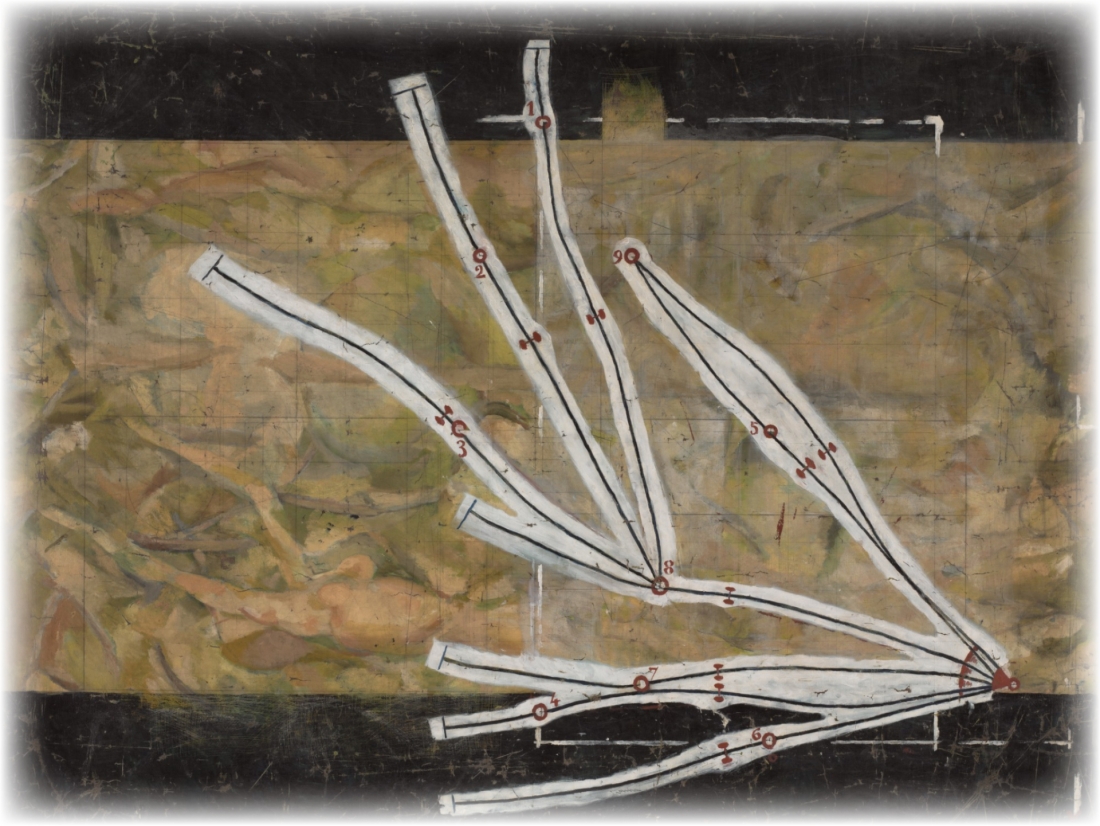
© Marcel Duchamp, Network of Stoppages (1914)
Info sobre horário e bilhetes
Tue
31.05
18:30
RivoliSmall Auditorium
Aditional info
- Price Free entrance
Age recommendation 6+