Sinopse
This year marks the 120th anniversary of the birth and the 50th anniversary of the death of one of the great geniuses of cinema, Luchino Visconti (1906–1976), and at the Teatro Campo Alegre we are revisiting his work with a series of seven of his films (Visconti directed 14 films and several segments of collective films throughout his life).
Visconti, who was born into a Milanese aristocratic family and grew up amidst the theatres and opera houses, and who from a very young age rubbed shoulders with the great opera singers and writers, on one of his many trips to Paris, where he met and befriended Bernstein and Coco Chanel, and the writers André Gide and Jean Cocteau, also began to frequent the world of cinema and would go on to work as an assistant to Jean Renoir on Une Partie de campagne (1936). In the early 1940s, he moved to Rome (his mother, to whom he was very close, had died in 1939 and his father shortly afterwards, in 1941), and became involved with the young intellectuals of the magazine Cinema, which was a centre of opposition to the fascist regime and to which he would contribute some seminal articles.
Around this time, he began working, in collaboration with several friends, including Antonio Pietrangeli and the writer Alberto Moravia, on a screenplay loosely inspired by James Cain’s novel The Postman Always Rings Twice, which Renoir had introduced him to, and which would give rise to his first film, Ossessione (1943), which premiered with several cuts imposed by the censors and was vilified by Benito Mussolini’s son. Ossessione, which has not yet been commercially released in Portugal, is also regarded as the first Italian neorealist film.
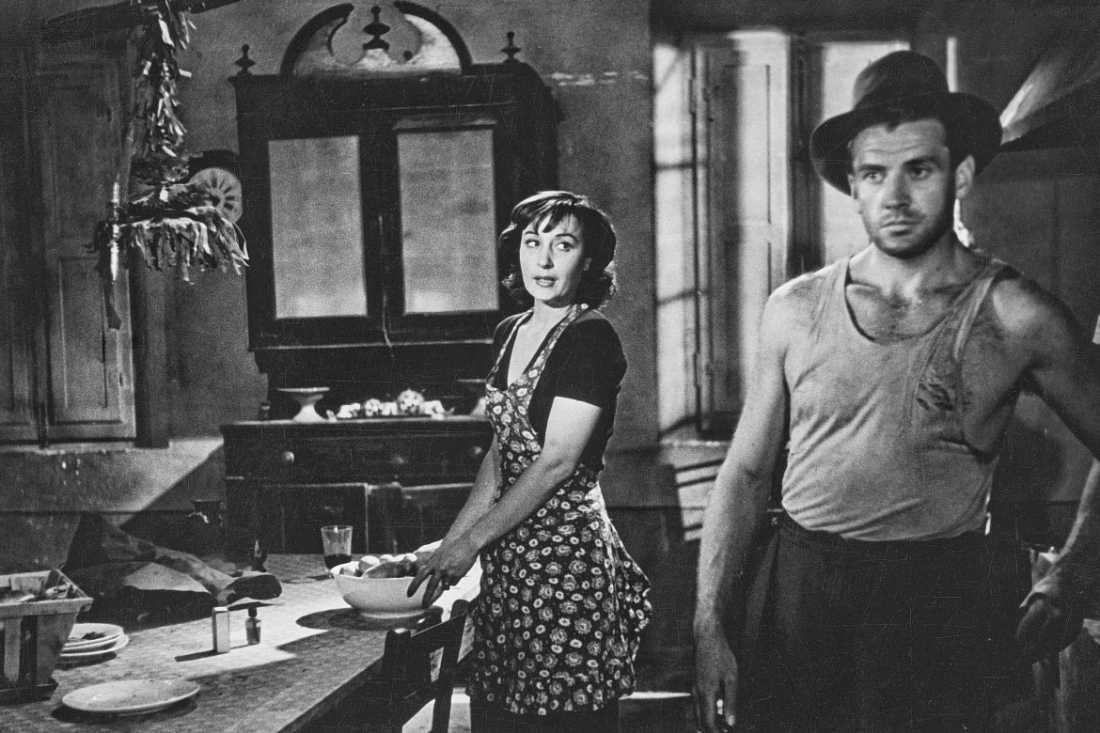
During those years of the Second World War and the resistance, Visconti became involved with the Italian Communist Party. He devoted himself passionately to the theatre, directing, amongst others, plays by Cocteau, Hemingway, Sartre, Dostoevsky and Tennessee Williams. He would regularly return to his productions. Towards the end of the decade, following a commission that would later take a different turn, he made the seminal La terra trema (1948), centred on the struggle of Sicilian peasants for land, which premiered at the Venice Film Festival, where it won an award.
Senso (1954) is one of his masterpieces, in which he effectively rewrites Camillo Boito’s novel: “The streets of Venice (whoever has never seen Senso has never seen Venice), the granaries of Lonedo (whoever has never seen *Senso* has never seen Palladio), the squares of Verona (whoever has never seen *Senso* has never seen Sanmicheli) were, in 1954, the excessive, heightened and extravagant stages for the most phantom-like presence of the most phantom-like of voices.” [João Bénard da Costa]. In 1957, he directed White Nights, based on Dostoevsky, which won the Silver Lion at Venice—an extraordinary interplay between diction and décor, in which he worked with Maria Schell, Marcello Mastroianni and Jean Marais.
The 1960s began with Rocco and His Brothers, starring Claudia Cardinale and Alain Delon, with whom he would work again; a romantic and family-oriented film (it is the story of a mother and her five children, says Visconti), which, despite some cuts by the censors, was his first major critical and commercial success, following the Special Jury Prize in Venice.
Following a prolonged hospital stay due to a thrombosis in the early 1970s, he would go on to give us two more absolutely extraordinary films: Conversation Piece (1974), once again starring Burt Lancaster, Helmut Berger and Silvana Mangano – a masterpiece that encapsulates his obsessions and demons, and perhaps his most personal film – and, finally, another masterpiece, The Innocent, a tale of infidelity and betrayal within 19th-century Italian aristocracy, based on the novel by Gabriele D’Annunzio, whom he had known since childhood. Visconti died in March 1976, before the film’s premiere in May at the Cannes Film Festival, which this year honoured him with a screening of a newly restored version of the film.
As we know, many of Visconti’s films were subject to censorship cuts, and many of them never received a commercial release in Portugal. We will be screening these seven films, from 23 to 31 July at the Teatro Campo Alegre, in their entirety and in all their splendour, as they deserve, in restored versions. — Medeia Filmes
© DR
Info sobre horário e bilhetes
Aditional info
- Price
5.50€ (per session)
Acessibilidades do espetáculo


Author's bio text
PROGRAMME
23/07 Thu
21:30 – OSSESSIONE
24/07 Fri
20:45 – THE INNOCENT
25/07 Sat
15:30 – OSSESSIONE
18:15 – SENSO
21:15 – LA TERRA TREMA
26/07 Sun
15:30 – CONVERSATION PIECE
17:45 – ROCCO AND HIS BROTHERS
21:45 – THE INNOCENT
27/07 Mon
21:30 – SENSO
28/07 Tue
20:45 – ROCCO AND HIS BROTHERS
29/07 Wed
21:30 – WHITE NIGHTS
30/07 Thu
21:30 – CONVERSATION PIECE
31/07 Fri
20:45 – WHITE NIGHTS
Ficha Técnica
- OSSESSIONE (1943) 2h20 | 12+
LA TERRA TREMA (1948) 2h20 | 12+
SENSO (1954) 2h03 | 12+
WHITE NIGHTS (1957) 1h37 | 12+
ROCCO AND HIS BROTHERS (1960) 2h59 | 16+
CONVERSATION PIECE (1974) 2h01 | 12+
THE INNOCENT (1976) 1h52 | 16+