Sinopse
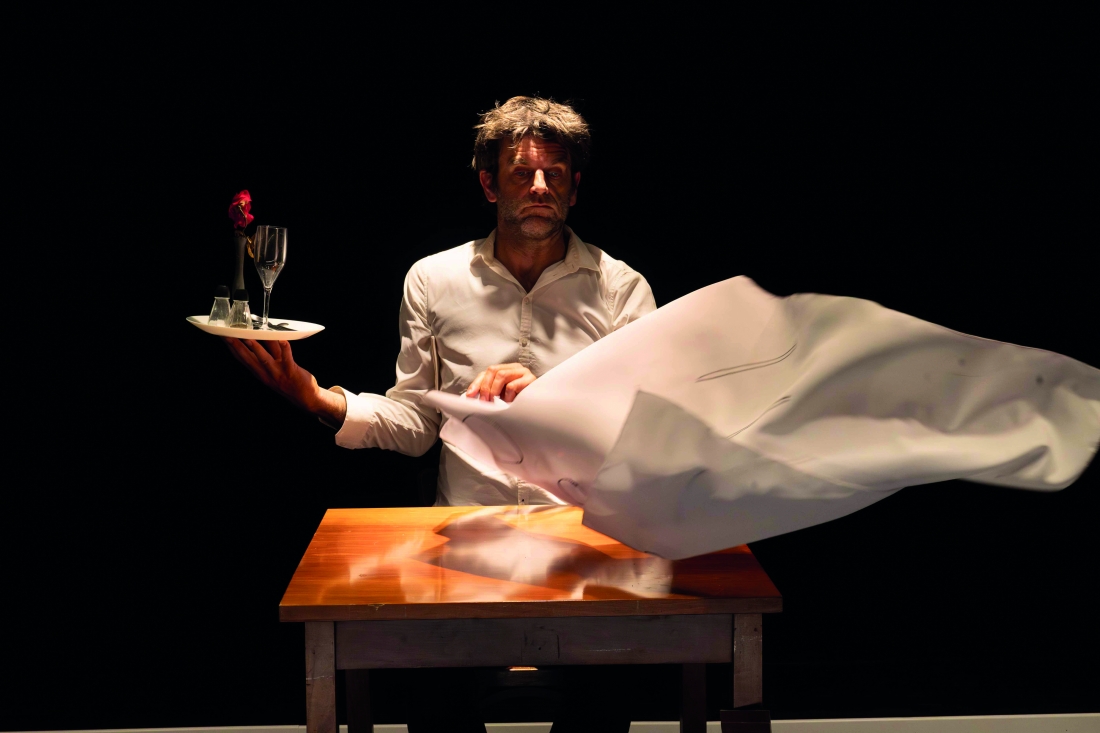
L'amour du risque [Love of risk] is a ballet for robot vacuum cleaners. A man is waiting to be served for a candle-lit dinner accompanied by romantic music. Here, the service is automated and managed by artificial intelligence with somewhat limited capacities. Robots move about randomly and come and go into space, creating a hypnotic dance. During the performance, their behaviour is increasingly disordered, and they even seem to have human intentions. A question of balance, on the edge of the precipice, an accident is never far away. — Compagnie Bakélite
automation
disaster
adventure
© Greg Bouchet
Info sobre horário e bilhetes
3.12
Thu
10:30
14:30
4.12
Fri
10:30
5.12
Sat
16:00
Aditional info
Price
2.50€
-
Duration
30min
- Age rating
6+
- schools
- families
Acessibilidades do espetáculo


Author's bio text
Founded in Rennes in 2005, Compagnie Bakélite creates inventive family theatre that blends dark comedy with absurd imagination. With the artistic direction of Olivier Rannou, the company is known for its meticulous visual storytelling, transforming everyday objects into powerful theatrical worlds through precision, creativity, and humour. Inspired by cinematic techniques, their performances playfully subvert visual codes in productions such as L’Affaire Poucet, Stick-Up, The Galley, and Hostile. Bakélite is a collaborative project between artists Aurélien Georgeault-Loch, Alan Floc’h, and Guillaume Alexandre, with productions directed by Rannou and produced by Charlène Faroldi.
Ficha Técnica
Staging
Olivier Rannou
Construction and performance
Morien Nolot, Olivier Rannou
Artistic collaborator
Ariel Doron
Light design
Alan Floc’h
Project development support
Charlène Faroldi, Louise Gérard, Jessica Bodard
Co-produced by
L’Hopitau - Laboratoire des Arts de la marionnette, La Chapelle-sur-Erdre, Théâtre de Cuisine, Marseille Centre culturel de Liffré
- Pre-licence
Le Théâtre de Laval, Centre National de la MArionnette
Residencies
Jungle-Lieu partagé, Le Rheu / Théâtre de Poche - Hédé-Bazouges
With the financial support of Brittany Regional Department of Culture, the Brittany Regional Council, the Departmental Authority of Ille-et-Vilaine and the City of Rennes